You’ve seen it — the white, chalky crust that forms on your shower heads and faucets.
And you recognize the distinct taste of municipal tap water that travels from the Colorado River or local groundwater aquifers.
Orange County homeowners face a two-front battle: water hardness and water quality.
The language gets confusing. You’ll see terms like “conditioning,” “softening,” “filtering,” and “purifying” used interchangeably in marketing materials. They’re not the same thing.
This guide breaks down the mechanical and functional differences between water filtration and water softening to help you determine which system — or combination of systems — will protect your plumbing infrastructure and improve your home’s water quality.
The Core Difference: Chemistry vs. Mechanics
- Water Softeners treat water hardness. They address the mineral content (calcium and magnesium) that causes scale buildup.
- Water Filters treat water contamination. They address impurities, chemicals, sediment, and bacteria that affect taste, odor, and safety.
A softener protects your house (pipes, appliances, water heater). A filter protects the people inside the house (drinking, cooking, bathing).
Deep Dive: Water Softeners
Orange County has some of the hardest water in the country.
Hardness is measured in Grains Per Gallon (GPG). Anything over 7 GPG is considered “hard.” Many areas in Southern California register between 15 and 25 GPG. Yikes — that’s almost like wet concrete!
How It Works
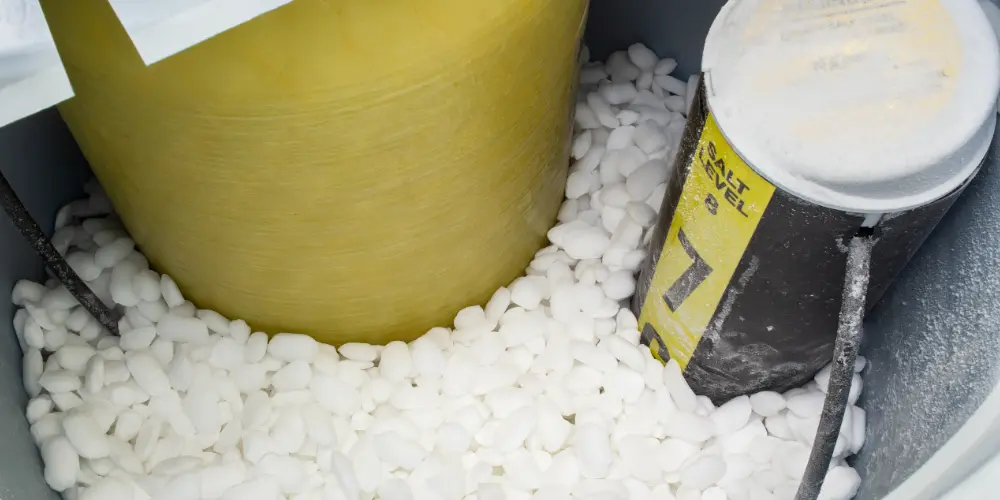
True water softeners use a process called ion exchange. The system consists of a resin tank and a brine (salt) tank.
- Water flows over resin beads inside the tank.
- The beads carry a negative charge and attract positively charged minerals like calcium and magnesium.
- The minerals stick to the beads, removing them from the water supply.
- The system eventually “regenerates” by flushing the beads with a saltwater solution, washing the minerals down the drain.
Signs You Need a Water Softener
If you notice the following issues, hardness is likely the culprit:
- Scale Buildup: White, crusty deposits on faucets, shower doors, and tea kettles.
- Appliance Failure: Dishwashers and washing machines failing prematurely due to clogged internal lines or burned-out heating elements.
- Water Heater Efficiency: Scale buildup inside the tank forces the heater to work harder, increasing energy bills.
- Dry Skin and Hair: Minerals dry out skin and prevent soap from lathering effectively.
- Stiff Laundry: Clothes feel rough and look dingy after washing.
The Maintenance Reality
Installing a water softener is a commitment to ongoing maintenance.
- Salt Refills: You must add bags of potassium or sodium chloride pellets to the brine tank every 4–8 weeks.
- Regeneration Noise: Systems often regenerate at night and can be noisy.
- Water Usage: The regeneration cycle uses water to flush the system.
Deep Dive: Water Filtration
Filtration ranges from simple pitcher filters to complex whole-home systems. In Orange County, the primary goal of filtration is removing chlorine and chloramines used by the city for sanitation, as well as sediment and volatile organic compounds (VOCs).
How It Works
These are the most common methods of filtration for residential use:
- Activated Carbon: Water passes through carbon media. The carbon acts like a sponge, absorbing chemicals like chlorine, pesticides, and herbicides. This drastically improves taste and odor.
- Reverse Osmosis (RO): Water is forced through a semi-permeable membrane that blocks almost all contaminants, including dissolved solids, lead, and fluoride. This is typically used at a single point of use, like the kitchen sink.
- Sediment Filters: A physical barrier that catches rust, sand, and dirt particles.
Signs You Need a Water Filter
Filtration is the answer if you are experiencing:
- Bad Taste or Odor: Water smells like a swimming pool (chlorine) or has a metallic taste.
- Cloudy Water: Visible particles or turbidity in your glass.
- Health Concerns: You want to remove specific contaminants like lead, nitrates, or pharmaceutical runoff.
The Maintenance Reality
Filtration maintenance requires strict adherence to schedules.
- Cartridge Changes: Filters clog over time. Failing to change them renders the system useless or can even release bacteria back into the water.
- Membrane Replacement: RO membranes last longer (2–3 years) but are more expensive to replace.
The Hybrid Approach: Why Most OC Homes Need Both
For the average suburban homeowner in this region, choosing between the two is often a false dichotomy. Because our water is both hard (mineral-heavy) and treated with sanitizing chemicals (chlorine), a single system rarely solves the whole problem.
Scenario A: The Softener Only
If you only install a softener:
- Your pipes and appliances are protected.
- Your shower doors stay clean.
- However: The water will still taste like chlorine. You’re still drinking and cooking with municipal chemicals.
Scenario B: The Filter Only
If you only install a whole-house carbon filter:
- The water tastes great at every tap.
- You aren’t showering in chlorine.
- However: Scale will still destroy your tankless water heater. Your dishwasher will still leave spots on glassware.
The Whole-House Solution
Many homeowners opt for a dual-tank system or a comprehensive setup.
- Stage 1: Sediment pre-filter (protects the other equipment).
- Stage 2: Carbon filtration tank (removes chemicals/taste).
- Stage 3: Water softener (removes hardness).
- Stage 4 (Optional): Under-sink reverse osmosis in the kitchen for “bottled water quality” drinking water.
DIY Installation vs. Professional Help
Water treatment installation involves cutting into your home’s main water supply line.
DIY Feasibility: Intermediate
- Under-Sink Filters: High feasibility. Requires basic wrenching and connecting compression fittings.
- Whole-House Systems: Medium-High difficulty. You need to locate the main water loop (usually in the garage in OC homes).
- Plumbing Skills Required: You must be comfortable sweating copper pipe or using PEX and crimp rings. Incorrect installation can lead to significant flooding.
- Drainage: Softeners and RO systems require a drain line connection. You must know how to tap into a drain pipe correctly to prevent backflow or sewer gas leaks (using an air gap).
If your home doesn’t have a pre-plumbed “softener loop,” the difficulty level increases significantly, as you may need to route pipes through walls or concrete.
Cost-Benefit Analysis
When planning this project, look beyond the upfront hardware cost.
Water Softener ROI
- Extended Appliance Life: A water heater can last 50% longer with soft water.
- Detergent Savings: You will use 50–70% less soap and detergent for laundry and dishes.
- Energy Efficiency: A clean heat exchanger in your water heater transfers heat more efficiently than one coated in scale.
Water Filter ROI
- Bottled Water Elimination: A reverse osmosis system eliminates the need for buying cases of water, saving hundreds of dollars annually.
- Health: Reduced exposure to potential carcinogens and contaminants.
Summary Checklist
Use this list to finalize your decision:
- Choose a Softener if: You have scale buildup, dry skin, and want to protect plumbing investments.
- Choose a Filter if: You hate the taste/smell of tap water or have specific contaminant concerns.
- Choose Both if: You live in Orange County and want to maximize home value, comfort, and appliance longevity.
FAQs: Water Filtration vs Water Softening
Q: Can a water softener purify water for drinking?
No. A water softener removes calcium and magnesium minerals. It doesn’t remove bacteria, viruses, chlorine, lead, or other chemical contaminants. It is strictly for water conditioning, not purification.
Q: Does a whole-house filter remove hardness?
Generally, no. Standard carbon filters remove chemicals like chlorine but leave dissolved minerals in the water. Some “salt-free conditioners” claim to prevent scale, but they don’t actually remove the hardness minerals from the water as a traditional softener does.
Q: How much water does a reverse osmosis system waste?
RO systems do produce wastewater (brine) during the filtration process. Older systems wasted up to 4 gallons for every 1 gallon produced. Newer, high-efficiency models with permeate pumps have reduced this ratio to roughly 1:1 or 2:1.
Q: Is soft water safe to drink?
Yes, for most people. However, the ion exchange process adds a small amount of sodium to the water. If you’re on a strict low-sodium diet prescribed by a doctor, you should install a reverse osmosis system in the kitchen to remove that sodium, or use potassium chloride pellets instead of salt.
Q: How often do I need to add salt to my softener?
This depends on your water hardness and household water usage. On average, a family of four in Orange County will need to add one 40-pound bag of salt every month or two. Check the tank monthly to ensure the salt level is above the water level.
Q: Can I install a system outside?
In Southern California, outdoor installations are possible because we rarely freeze, but they aren’t ideal. Direct sunlight can damage fiberglass tanks and promote algae growth in clear filter housings. If installing outside, you must build a shaded enclosure or use manufacturer-approved weather covers.
Q: What is a “salt-free” softener?
Technically, there’s no such thing as a salt-free softener. These are “descalers” or “conditioners.” They crystallize the minerals so they don’t stick to pipes, but the minerals remain in the water. They are maintenance-free but less effective at preventing spots on dishes or improving soap lather.
Q: Will a water filter reduce my water pressure?
It can. If the filter is undersized for the home’s flow rate demand, or if the filter cartridge is clogged with sediment, you will notice a pressure drop. Size your system according to your home’s bathroom count and peak flow rate (GPM) to avoid this.